Posted on

Three types of Breathing

Change Your Breath, Change Your Life | Lucas Rockwood | TEDxBarcelona

We do it as long as we live but mostly aren’t aware
of it: breathing. In his talk Lucas breaks down the
fundamentals of yoga breathing in a way that you
can easily remember and apply to your practice.
Lucas shows us how three breathing practices
water, whiskey, or coffee – can be used as a tool and help us to overcome any situation.

With a formal yoga training background in Hot
Yoga, Ashtanga Yoga, Gravity Yoga, and the Yoga
Trapeze®, Lucas has studied with some of the
most well-respected teachers on the planet. His
most influential teachers (all of whom he studied
with personally) include Sri K. Pattabhi Jois, Paul
Dallaghan, Alex Medin, Gabriel Cousens MD, and
SN Goenka.

Lucas founded Absolute Yoga Academy in 2006,
one of the top 10 yoga teacher training schools in
the world with 2,000 certified teachers (and
counting) and courses in Thailand, Holland, the
United Kingdom, and the Philippines.

In 2013, Lucas founded YOGABODY Fitness, a
revolutionary new yoga studio business model
that pays teachers a living wage and demystifies
yoga by making the mind-body healing benefits of
the practice accessible to everyone.

In search of nutritional products designed
specifically for achy yoga students’ bodies, Lucas
worked with senior nutritional formulator Paul
Gaylon and founded YOGABODY Naturals in the
back of his yoga studio a year later. The company
has gone from strength to strength and is now a
world-renowned nutrition, education, and
publishing organization serving 81 countries.

A foodie at heart, Lucas was a vegan chef and
owned and operated health food restaurants prior
to diving deep into the yoga world. He is also a
highly acclaimed writer, radio show host, TV
personality, business consultant, weight loss
expert, and health coach. This talk was given at a
TEDx event using the TED conference format but
independently organized by a local community.

Change Your Breath, Change Your Life | Lucas
Rockwood | TEDxBarcelona

Learn more at https://www.ted.com/tedx
Posted on

Cognitive Ease

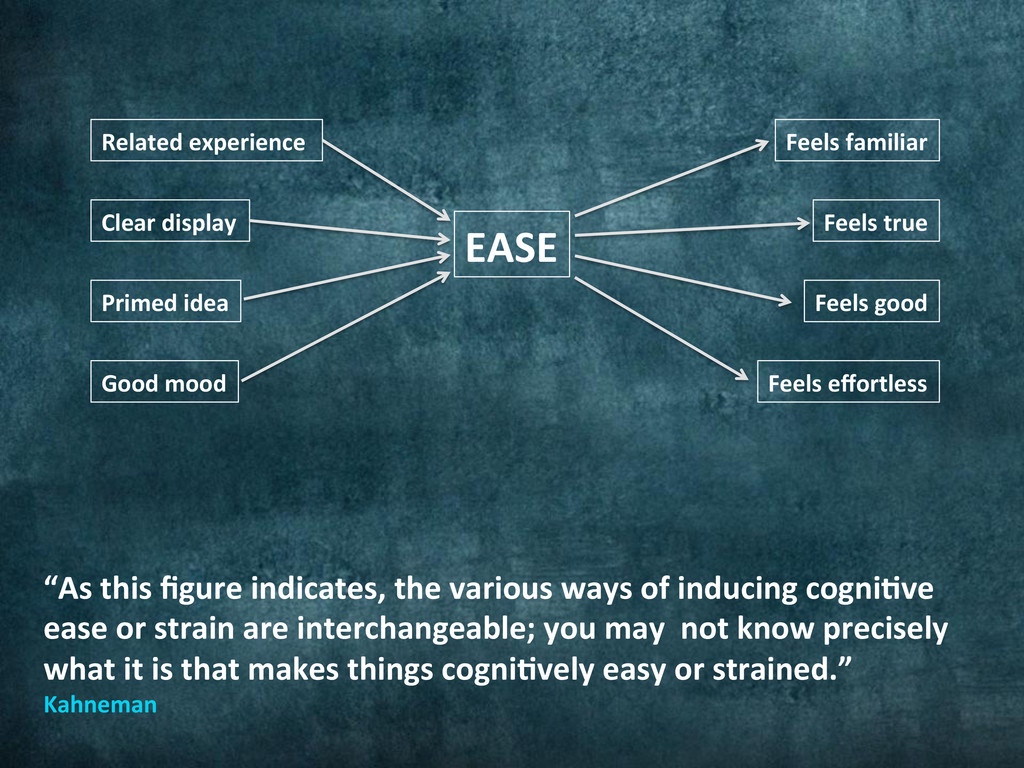
Cognitive Ease chart

Cognitive ease or fluency is the measure of how easy it is for our brains to process information. … The Cognitive ease principle reveals that when people have to switch to the second system of thinking, causing cognitive strain, they become more vigilant and suspicious.

Frequent repetition can be enough to convince people to believe things that are not true because familiarity generates a sense of cognitive ease. Called the mere-exposure effect, advertisers make use of it, but they aren’t the only ones. Information that is easy to understand also gives us a sense of cognitive ease.

Humans tend to avoid stressful and demanding cognitive strain, often making them vulnerable to many biases. This “laziness” and desire for cognitive ease often invites individuals to a world of irrationality where the decisions made can be detrimental.

Cognitive Ease – Veritasium
Posted on

Cantor’s threefold division of infinity

Excerpts from Infinity and the Mind

Rudy Rucker
Infinity and the mind by Rudy Rucker
Infinity and the Mind

… This threefold division [of infinity] is due to Cantor, who, in the following passage, distinguishes between the:

  • Absolute Infinite
  • Physical infinities
  • Mathematical infinities

The actual infinite arises in three contexts: first when it is realized in the most complete form, in a fully indepen dent other-worldly being, in Deo, where I call it the Absolute Infinite or simply Absolute; second when it occurs in the contingent, created world; third when the mind grasps it in abstracto as a mathematical magnitude, number, or order type. I wish to make a sharp contrast between the Absolute and what I call the Transfinite, that is, the actual infinities of the last two sorts, which are clearly limited, subject to further increase, and thus related to the finite,

PHYSICAL INFINITIES

There are three ways in which our world appears to be un bounded and thus, perhaps, infinite. It seems that time cannot end. It seems that space cannot end. And it seems that any interval of space or time can be divided and subdivided endlessly. We will consider these three apparent physical infinities in three subsections.

Temporal Infinities

One of the chief consequences of Einstein’s Special Theory of Relativity is that it is space-time that is fundamental, not isolated space which evolves as time passes. I will not argue this point in detail here, but let me repeat that on the basis of modern physical theory we have every reason to think of the passage of time as an illusion. Past, present, and future all exist together in space-time.

So the question of the infinitude of time is not one that is to be dodged by denying that time can be treated as a fixed dimension such as space. The question still remains: is time infinite? If we take the entire space-time of our universe, is the time dimension infinitely extended or not?

Möbius strip ​
Möbius strip

Spatial Infinities

Whether or not our space is actually infinite is a question that could conceivably be resolved in the next few decades. Assuming that Einstein’s theory of gravitation is correct, there are basically two types of universe: i) a hyperspherical (closed and
unbounded) space that expands, and then contracts back to a point; ii) an infinite space that expands forever. It is my guess that case i) will come to be most widely accepted, if only because the notion of an actually infinite space extending out in every direction is so unsettling.

The fate of the universe in case i) is certainly more interesting, since such a universe collapses back to an infinitely dense space-time singularity that may serve as the seed for a whole new universe. In case il), on the other hand, we simply have cooling and dying suns drifting further and further apart in an utterly empty black immensity … and in the end there are only ashes and cinders in an absolute and eternal night.

The question we are concerned with here is whether or not space is infinitely large. There seem to be three options: i) There is some level n for which -dimensional space is real and infinitely extended. The situation where our three-dimensional space is infinitely large falls under this case. ii). There is some n such that there is only one n-dimensional space. This space is to be finite and unbounded, and there is to be no reality to n + 1 dimensional space.

The situation where our three-dimensional space is finite and unbounded, and the reality of four-dimensional space denied, falls under this case. iii). There are real spaces of every dimension, and each of these spaces is finite and unbounded. In this case we either have an infinite number of universes, duoverses, triverses, etc., or we reach a level after which there is only one n-verse for each n.

Read more in his book Infinity and the Mind