Posted on

Noise by Daniel Kahneman | 3 Distinctions

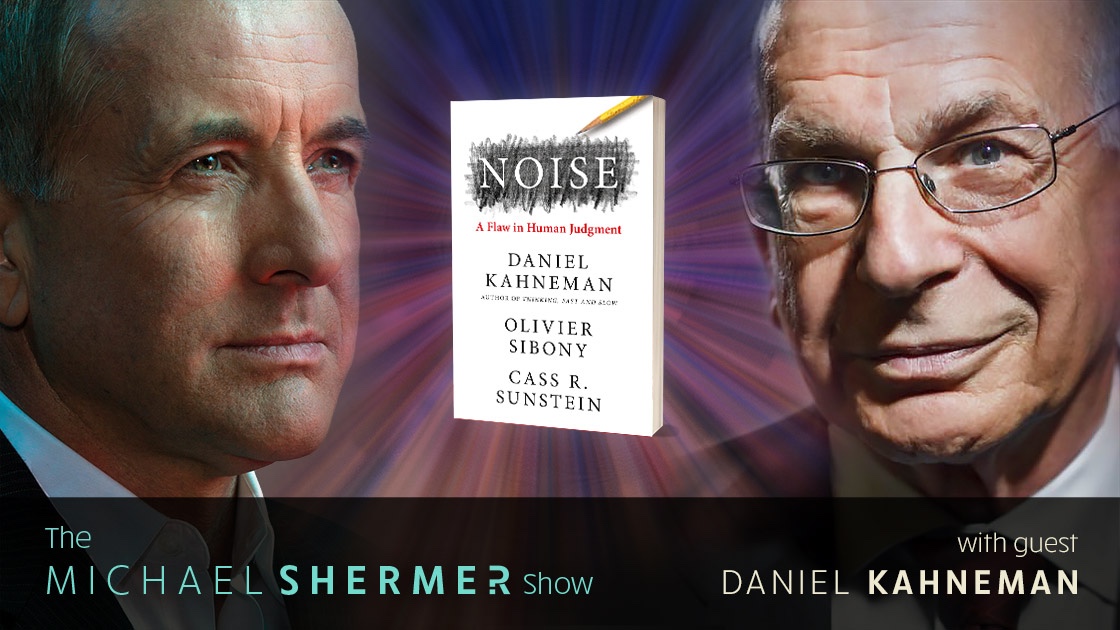
Noise | Michael Shermer (left) and Daniel Kahneman (right)

The Michael Shermer Show with Daniel Kahneman – Noise: A Flaw in Human Judgment

DESCRIPTION

Imagine that two doctors in the same city give
different diagnoses to identical patients. Now
imagine that the same doctor making a different
decision depending on whether it is morning or
afternoon, or Monday rather than Wednesday.
This is an example of noise: variability in
judgments that should be identical.

Shermer speaks with Nobel Prize winning
psychologist and economist Daniel Kahneman
about the detrimental effects of noise and what
we can do to reduce both noise and bias, and
make better decisions in: medicine, law, economic
forecasting, forensic science, bail, child
protection, strategy, performance reviews, and
personnel selection.

Video clip – 3 minutes

Noise by Daniel Kahneman | 3 Distinctions

SUPPORT THE PODCAST
If you enjoy the podcast, please show your
support by making a donation. Your patronage will
ensure that sound scientific viewpoints are heard
around the world.
https://www.skeptic.com/donate/
SPONSOR
Wondrium
https://wondrium.com/shermer
SPONSOR
Brilliant
https://brilliant.org/MichaelShermer/

Listen to The Michael Shermer Show via Apple
Podcasts, Spotify, Amazon Music, Google
Podcasts, Stitcher, iHeartRadio, and Tuneln.
https://www.skeptic.com/michael-sherm..

Full Video – Noise by Daniel Kahneman

Full video at https://youtu.be/5CFjERpwFys
Posted on

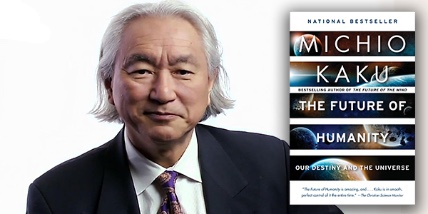
Michio Kaku: 3 mind-blowing predictions about the future

Michio Kaku

What lies in store for humanity? Theoretical physicist Michio Kaku explains how different life will be for your descendants—and maybe your future self, if the timing works out.

15 min

with
Michio Kaku

Michio Kaku: 3 mind-blowing predictions about the future
  1. We will become a space-faring species
  2. We will expand the brain’s capabilities
  3. We will defeat cancer

About

Michio Kaku (Japanese: カク ミチオ, 加来 道雄, born January 24, 1947) is an American theoretical physicist, futurist, and popularizer of science (science communicator). He is a professor of theoretical physics in the City College of New York and CUNY Graduate Center. Kaku is the author of several books about physics and related topics and has made frequent appearances on radio, television, and film. He is also a regular contributor to his own blog, as well as other popular media outlets. For his efforts to bridge science and science fiction, he is a 2021 Sir Arthur Clarke Lifetime Achievement Awardee.

Sources
Posted on

The Metre – the repeating circle & triangulation

The Metre (meaning measure) was one ten-millionth of the distance from the North Pole to the Equator! France embarked on a first large scale measurement. It took 7 years to measure the distance from Dunkirk to Barsalona. They used triangulation with an instrument called the Repeating Circle along with trigonometry.

The standardization of measurement: the Metre

Creating the Metre – a universal standard

By the 16th century, there we over 250,000 weights and measures in Europe. This effected trade, navigation, building plans, etc. Fire hoses would not connect from town to town. France chose to create a standard by measuring something unchangeable. They chose the Earth. Before this standardization, the human body (the Ruler of the land) would make new measurements upon gaining power.

The Repeating Circle

Repeating Circle
Repeating Circle

DESCRIPTION

This is one of two double repeating circles that Ferdinand Rudolph Hassler, the first superintendent of the U. S. Coast Survey, ordered from Edward Troughton in London in 1812, and that was shipped in 1815. The large circle may be angled from vertical to horizontal to the opposite vertical position. It is graduated to 10 minutes, and read by four verniers and two magnifiers to single minutes.

A repeating circle is a geodetic instrument with two telescopes that is designed to reduce errors by repeated observations taken on all parts of the circumference of a circle. The form was developed by the Chevalier de Borda, first executed by Etienne Lenoir in Paris around 1789, and popular for about 50 years.

Ref: F. R. Hassler, “Papers on Various Subjects Connected with the Survey of the Coast of the United States,” Transactions of the American Philosophical Society 2 (1825): 232-420, on 315-320 and pl. VII. “The Repeating Circle Without Reflection, as made by Troughton,” in The Cyclopaedia: or, Universal Dictionary of Arts, Sciences, and Literature, edited by Abraham Rees (London, 1819), Vol. VII, Art “Circle.”

Image credit:

NAME: repeating circle MAKER: Troughton and Simms PLACE MADE: United Kingdom: England, London MEASUREMENTS: overall: 32 1/8 in x 26 3/4 in x 17 in; 81.6356 cm x 67.945 cm x 43.18 cm upper circle: 17 1/2 in; 44.45 cm circle at base: 13 1/2 in; 34.29 cm telescope: 24 in; 60.96 cm overall; base: 16 3/4 in x 15 1/4 in x 16 in; 42.545 cm x 38.735 cm x 40.64 cm overall; horizontal circle: 13 in x 23 in x 20 in; 33.02 cm x 58.42 cm x 50.8 cm ID NUMBER PH.314640 CATALOG NUMBER 314640 ACCESSION NUMBER 208213


Continue reading The Metre – the repeating circle & triangulation