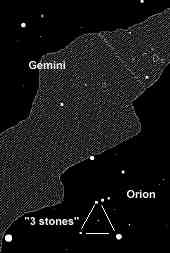
Three stones were set. They planted [the first stone], Jaguar Paddler, Stingray Paddler. . . . He planted the [second] stone, First Black Chak(?) . . . . The [third] stone was set [by] Great Itzamna. . . . It happened at Lying Down Sky.
Hades was one of the many children of Cronus and Rhea. Because an oracle once predicted to Cronus that one of his offspring would defeat him and steal his throne, the Titan decided to swallow all of his children alive the moment they came into the world. Rhea who yearned for a baby of her own, soon grew tired of this and decided to fool her husband. After giving birth to her youngest son Zeus she wrapped a stone in a baby’s blanket and gave it to Cronus to devour. She then quickly hid the infant safely away on the isle of Crete. Just as the Priestess promised, Zeus grew to manhood and returned to overthrow his father but not before giving him a potion that caused him vomit up the other siblings.
Out popped Poseidon, Hades, Hestia, Demeter and Hera. The Universe was then divided among the three brothers; Zeus, Poseidon and Hades by the drawing of lots. Zeus was granted the sky, Poseidon the sea and Hades the Underworld.
Cerberus | Laconian black-figure kylix C6th B.C. | National Archaeological Museum of Taranto
The land of the dead was protected by Hades’ three headed dog Cerberus. This creature allowed the shades to pass by freely but was sure to keep out all trespassers from the world of the living. He also made certain that once your soul passed theough the gates it was never able to leave again. Before being led to their new place of residence, the newly dead were required to drink from the Pool of Lethe.
Just one taste of this water of forgetfulness would leave the spirit void of all memories of his former life on earth. After drinking from the Pool of Lethe, the souls were next led before Minos, Rhadamanthys and Aeacus, the three judges of the Underworld. It was at this place where three roads meet that the eternal fate of the new arrivals was decided.
Minos, Rhadamanthys and Aeacus
Each spirit was then directed to travel down the road that best corresponded to the way he conducted his life on earth. Those who were neither virtuous or evil were sent back to the Fields of Asphodel. It was here that the joyless souls of heros languished without purpose, their only release being the libations of blood that were poured to them by the living.
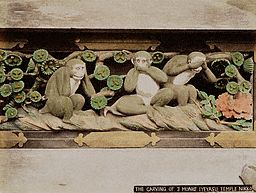
The three wise monkeys (Japanese: 三猿, san’en or sanzaru, or 三匹の猿, sanbiki no saru, literally “three monkeys”), sometimes called the three mystic apes,[1] are a pictorial maxim. Together they embody the proverbial principle to “see no evil, hear no evil, speak no evil”.[2]The three monkeys are Mizaru, covering his eyes, who sees no evil; Kikazaru, covering his ears, who hears no evil; and Iwazaru, covering his mouth, who speaks no evil.
There are various meanings ascribed to the monkeys and the proverb including associations with being of good mind, speech and action. In the Western world the phrase is often used to refer to those who deal with impropriety by turning a blind eye.[3]
In English, the monkeys’ names are often given as Mizaru,[4]Mikazaru,[5] and Mazaru,[6] but the last two names were corrupted from the Japanese originals.[7][8]