Posted on Leave a comment

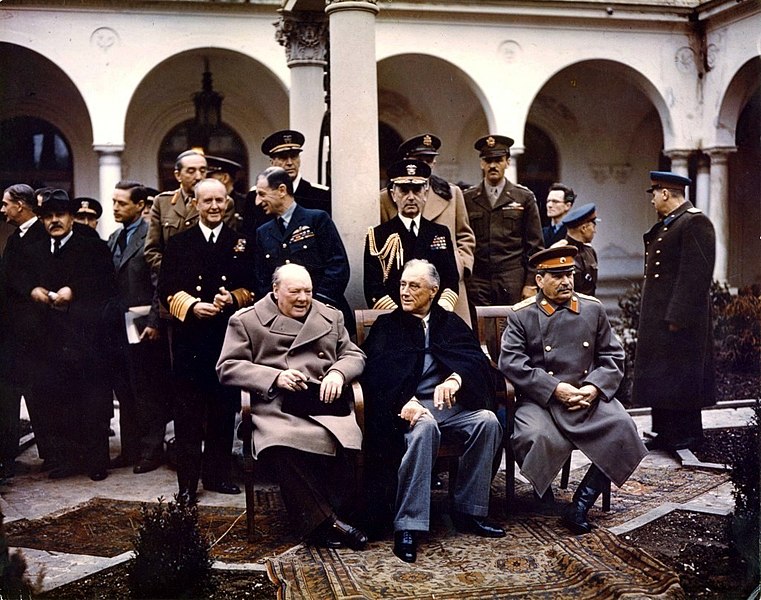
The Big Three – Churchill, Roosevelt, and Stalin

Yalta Conference 1945 Churchill, Stalin, Roosevelt
Churchill, Roosevelt, and Stalin—the leaders of the three major Allied powers—were known during World War II as the Big Three. The Big Three and their military advisers planned the strategy that defeated the Axis. Churchill and Roosevelt conferred frequently on overall strategy. Stalin directed the Soviet war effort but rarely consulted his allies.

The strategy

Churchill, Roosevelt, and Stalin
The Big Three – Churchill, Roosevelt, and Stalin

Roosevelt relied heavily on his military advisers, the Joint Chiefs of Staff. They consisted of General of the Army Henry H. Arnold, commanding general of the Army Air Forces; General of the Army George C. Marshall, chief of staff of the Army; Fleet Admiral Ernest J. King, chief of naval operations; and Fleet Admiral William D. Leahy, Roosevelt’s chief of staff. Churchill had a similar advisory body.

Tehran Conference
Tehran Conference

The main wartime disagreement among the Big Three concerned an Allied invasion of western Europe. Stalin constantly urged Roosevelt and Churchill to open a second fighting front in western Europe and thus draw German troops from the Soviet front. Both Roosevelt and Churchill supported the idea but disagreed on where and when to invade. The Americans wanted to land in northern France as soon as possible. The British argued that an invasion of France before the Allies were fully prepared would be disastrous. Instead, Churchill favored invading Italy first. His view won out.

The Big Three Churchill, Roosevelt & Stalin Discuss Post-War Europe (1945) War Archives

Roosevelt and Churchill first met in August 1941 aboard ship off the coast of Newfoundland. They issued the Atlantic Charter, a statement of the postwar aims of the United States and the United Kingdom. After the Japanese attacked Pearl Harbor, Roosevelt and Churchill conferred in Washington, D.C. The two leaders felt that Germany was a nearer and a more dangerous enemy than Japan. They decided to concentrate on defeating Germany first.

In January 1943, Roosevelt and Churchill met in Casablanca, Morocco. They agreed to invade the Mediterranean island of Sicily after driving the Germans and Italians from northern Africa. At the conference, Roosevelt announced that the Allies would accept only unconditional (complete) surrender from the Axis powers. Churchill supported him.

Roosevelt and Churchill first met with Stalin in November 1943 in Teheran, Iran. The Big Three discussed plans for a joint British and American invasion of France in the spring of 1944. They did not meet again until Germany neared collapse. In February 1945, Roosevelt, Churchill, and Stalin gathered at Yalta, a Soviet city on the Crimean Peninsula. They agreed that their countries would each occupy a zone of Germany after the war. France was to occupy a fourth zone. At the Yalta Conference, Stalin pledged to permit free elections in Poland and other countries in eastern Europe after the war. He later broke that pledge. Roosevelt died in April 1945, two months after the Yalta Conference.

The Treaty of Versailles

Posted on

Three Finger Challenge

Three Finger Challenge Dividing the Internet

The THREE FINGER CHALLENGE Is Dividing The Internet!


Inglorious Bastard's
Inglorious Bastard’s

In the movie Inglorious Bastard’s, the spy, undercover as a German officer, orders another round of whiskey, telling the bartender, “Drei Gläser (three glasses) and holding three fingers up — his index, middle, and ring finger. … A true German would have ordered “three” with the index, middle finger, and thumb extended.

three countries using three fingers

The French also start counting with their thumb for one. For two, they hold up the thumb and index finger. For three, they hold up the thumb, index finger and middle finger. In Costa Rica the three finger ‘OK” sign is used. 

Anti Defamation League says 'OK' hand sign not a white supremacist hate symbol
Anti Defamation League says ‘OK’ hand sign not a white supremacist hate symbol

One of America’s oldest civil rights organizations has said it does not think the thumb and forefinger “OK” hand gesture is a white supremacist sign.

The Anti-Defamtion League (ADL) issued the clarification after two journalists known to be supporters of Donald Trump made the sign while standing behind the podium at the White House press briefing room.

The two reporters vehemently denied they were either white supremacists or that they were making a sign in support of such views. However, the image of them sparked a storm on social media, with some commentators arguing that the symbol was a way to indicate ‘white power’, as reported by The Independent.

What’s Trending – Backstage Conversations Shira Lazar

Shira Lazar - Backstage Conversations

Video Sources: Shira Lazar
Posted on

Three ways to see an atom

Atom

A remarkable photo of a single atom trapped by electric fields has just been awarded the top prize in a well-known science photography competition. The photo is titled “Single Atom in an Ion Trap” and was shot by David Nadlinger of the University of Oxford
A remarkable photo of a single atom trapped by electric fields has just been awarded the top prize in a well-known science photography competition. The photo is titled “Single Atom in an Ion Trap” and was shot by David Nadlinger of the University of Oxford.

If there is no way in the world to see an atom, then how do we know that the atom is made of protons, electrons, neutrons, the nucleus and the electron cloud?

There are three ways that scientists have proved that these sub-atomic particles exist. They are direct observation, indirect observation or inferred presence and predictions from theory or conjecture.

Atomic model
Atomic model

Scientists in the 1800’s were able to infer a lot about the sub-atomic world from The Periodic Table of Elements by Mendeleyev gave scientists two very important things. The regularity of the table and the observed combinations of chemical compounds prompted some scientists to infer that atoms had regular repeating properties and that maybe they had similar structures.


J.J. Thompson
J.J. Thompson

Other scientists studying the discharge effects of electricity in gasses made some direct discoveries. J.J. Thompson was the first to observe and understand the small particles called electrons. These were called cathode rays because they came from the cathode, or negative electrode, of these discharge tubes. It was quickly learned that electrons could be formed into beams and manipulated into images that would ultimately become television. Electrons could also produce something else. Roentgen discovered X-rays in 1895. His discovery was a byproduct of studying electrons. Protons could also be observed directly as well as ions as “anode” rays. These positive particles made up the other half of the atomic world that the chemists had already worked out. The chemists had measured the mass or weight of the elements. The periodic chart and chemical properties proved that there was an atomic number also. This atomic number was eventually identified as the charge of the nucleus or the number of electrons surrounding an atom which is almost always found in a neutral, or balanced, state.

Ernest Rutherford
Ernest Rutherford

Rutherford proved in 1911, that there was a nucleus. He did this directly by shooting alpha particles at other atoms, like gold, and observing that sometimes they bounced back the way they came. There was no way this could be explained by the current picture of the atom which was thought to be a homogeneous mix. Rutherford proved directly by scattering experiments that there was something heavy and solid at the center. The nucleus was discovered. For about 20 years the nucleus was thought to consist of a number of protons to equal the atomic weight and some electrons to reduce the charge so the atomic number came out right. This was very unsettling to many scientists. There were predictions and conjectures that something was missing.

James Chadwick
James Chadwick

In 1932 Chadwick found that a heavy neutral particle was emitted by some radioactive atoms. This particle was about the same mass as a proton, but it had a no electric charge. This was the “missing piece” (famous last words). The nucleus could now be much better explained by using neutrons and protons to make up the atomic weight and atomic number. This made much better sense of the atomic world. There were now electrons equal to the atomic number surrounding the nucleus made up of neutrons and protons.

Wilhelm Conrad Röntgen raggi X

Mr. Roentgen’s x-rays allowed scientists to measure the size of the atom. The x-rays were small enough to discern the atomic clouds. This was done by scattering x-rays from atoms and measuring their size just as Rutherford had done earlier by hitting atoms with other nuclei starting with alpha particles.

Cyclotron - 1930 particle accelerator
Cyclotron – 1930 particle accelerator

The 1930’s were also the time when the first practical particle accelerators were invented and used. These early machines made beams of protons. These beams could be used to measure the size of the atomic nucleus. And the search goes on today. Scientists are still filling in the missing pieces in the elementary particle world. Where will it end? Around about 1890, scientists were lamenting the death of physics and pondering a life reduced to measuring the next decimal point! Discoveries made in the 1890’s proved that the surface had only been scratched.

Carbon Atomic Model
Carbon Atomic Model

Each decade of the 1900’s has seen the frontier pushed to smaller and smaller objects. The explosion of knowledge has not slowed down and as each threshold has been passed the amount of new science seems to be greater even as we probe to smaller dimensions. Current theories (if correct) imply that there is even more below the next horizon awaiting discovery

Text Author: Paul Brindza, Experimental Hall A Design Leader

Source: https://education.jlab.org/qa/history_04.html