
 ACCORDING to the latest authority (Murray. " A New English Dictionary," 1887), Billiards is so named from " billard, 'a cue,' originally 'a stick with curved end; ' diminutive of bille, piece of wood, stick." Other derivations are balyards (a game played with balls and yards or sticks, Johnson), and billard (French bille, ball and suffix ard, Todd).
The origin of the game of Billiards is even more obscure than its etymology. In the Nouveau Dictionnaire, the game is said to have been invented by the French. Some ascribe the invention to Henrique Devigne, an artist, who flourished in the time of Charles IX., about 1571. Bouillet, Dictionnaire Universel des Sciences, magnanimously hands back the invention to the English. He says:-" The game of Billiards appears to be derived from the game of bowls. It was very anciently known in England, where perhaps it was invented. It was brought into fashion in France by Louis XIV., whose physicians recommended this exercise to him after eating. "Dr. Johnson argues that the game is probably English, Todd is of opinion that it is French; the Acadesmie des Jeux says:- "It would appear that Billiards was invented in England."
Carom billiards, also called French Billiards, is a game played with three balls (two white and one red) on a table without pockets, in which the object is to drive one of the white balls (cue ball) into both of the other balls. Each carom thus completed counts one point. In a popular version of the game called three-cushion billiards, the cue ball is played so that it strikes an object ball and three or more cushions (not necessarily different cushions) in any order before striking the second object ball.
The three balls are red, white, and white with a spot. The standard table in carom billiards is 5 by 10 feet (152 by 305 cm), although smaller tables of similar proportions are also used. The table is marked with three spots, one near its head, one at its centre, and one near its foot. To begin play, the first player may select either white ball as cue ball. The red ball is spotted on the foot spot, a white ball on the head spot, and the cue ball within six inches directly to either side of the white object ball.
 The cue ball must contact the red ball first on the break (first) shot; on subsequent shots either red or white may be the first ball hit. If the first player scores on his opening shot, he may select either white ball as cue ball on his second shot. Subsequently, however, he must cue the white ball used on that second shot and his opponent must cue the other. When a player fails to score, he yields to his opponent, who plays the balls as they have been left. A game is usually continued until one player scores an agreed number of points, often 50. Shooting the wrong cue ball incurs a penalty of one point and loss of turn.
Pool & Billiards Frequently Asked Questions
CUT-THROAT
A common three player game, better socially than as a test of skill.
Each player takes five balls, 1-5, 6-10, and 11-15, and the last player
with a ball on the table wins, so the goal is to sink your opponents'
balls. There are several variations. The penalty for a foul is to
bring one of each of the other players' balls back onto the table.
THREE BALL
A social game for two to "n" players. Each player seeks to pocket
a rack of three balls in the least number of shots (including the
break). Scratches count as an extra shot. Winner gets the pot. If
there's a tie for low score, the game rolls over to another round and
all players re-ante.
Continue reading Billiards



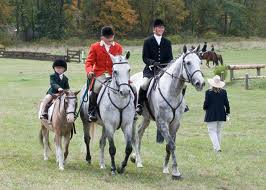 A three-day event also called HORSE TRIALS, equestrian competition, testing the overall abilities of horse and rider in competition at dressage, cross-country and endurance riding, and stadium show jumping.


