
 Temple from Templum is the same word as the Greek temenos, from temnw to cut off, means to separate some special place from the rest of the land. Usually religion rites were held outside the temple in front of the temple at an altar. With a few exceptions (for example temple to Apollo on Delos) most temples face east as the priests faced the direction of the rising sun when making offerings to the gods.
A shrine is stronger than a tower to save, A shield that none may cleave. Aeschylus The Suppliants
Persons were protected in the sacred space of the Temenos, they could not be taken out without their will. They enjoyed the right of asylia (or today asylum, from sylan “to steal”, ) (the right not to be taken or stolen out).
Doric Temples
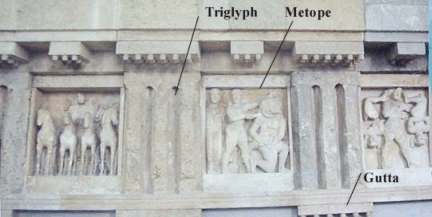
Greek Doric temples have usually a pattern under the pediment known as triglyphs (three cuttings) and metopes. The triglyphs alternate with the metopes across the front of the temple. Triglyphs have three parts, and then in between the triglyphs are the metopes. The frieze often was an alternating set of triglyphs and metopes.
The Doric and Ionic Order are the main structural systems of Greeks temples (type of column, decoration, etc). The third so-called Corinthian Order is similar to the Ionic Order with differences mainly in the column decoration.
Continue reading Temples and the Doric, Ionic and Corinthian Orders
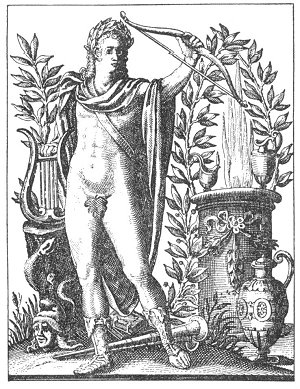 The worship of Apollo included the establishment and maintenance of places of prophecy by means of which the gods could communicate with mankind and reveal futurity to such as deserved the boon. The early history of Greece abounds with accounts of talking trees, rivers, statues, and caves in which nymphs, dryads, or dæmons had taken up their abodes and from which they delivered oracles. While Christian authors have tried to prove that oracular revelations were delivered by the Devil for the purpose of misleading humanity, they have not dared to attack the theory of oracles, because of the repeated reference to it in their own sacred writings.
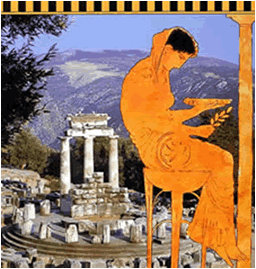 “… It was here that the Olympian gods spoke to mortal men through the use of a priesthood, which interpreted the trance-induced utterances of the Pythoness or Pythia. She was a middle-aged woman who sat on a copper-and-gold tripod, or, much earlier, on the “rock of the sibyl” (medium), and crouched over a fire while inhaling the smoke of burning laurel leaves, barley, marijuana, and oil, until a sufficient intoxication for her prophecies had been produced.”


