Posted on

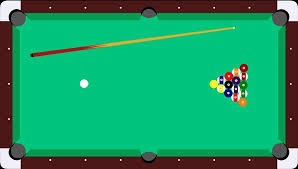
Three rail kicks | pool

pool table

As with the one-rail and two-rail systems, the three-rail (or more) system works very similar. Use a known reference line, then use a spot in the distance for any cue ball position that can hit the same starting rail. For 3+ rails the distance to the spot becomes less and less of an importance.

You can pick a spot varying many feet and still have good accuracy on the shot. As a rule of thumb, think one-table away for one-rail kicks, two-tables away for two-rail kicks, and three or more tables away for 3+ rail kicks.

Three rail strategy​
Three rail strategy

Normally this shot would come across as very difficult, but with a little knowledge we can make this a high percentage shot.

Three rail kick

Billiards vs pool

‘Billiards’ and ‘pool’ are two words that are often interchanged because they refer to games played on similar-looking tables with a cue and balls. However, what many people may not realize is that they actually have different meanings—and some striking differences in table features!

In its original use, billiards refers to any type of cue sport, including carom billiards, pool, and snooker. On the other hand, pool specifically refers to a game played on a pool table. 

Traditionally, billiards tables do not have pockets. As such, the various games are referred to as carom billiards, or pocketless billiards. In contrast, pool tables (or pocket billiards tables) have six pockets, including pockets in each corner and one in the middle of each long side.


Source: https://blattbilliards.com
Posted on

The 3 uses of currency | crypto

Real Time with Bill Maher
Real Time with Bill Maher 4/14/2003

A talk with Ben McKenzie about cryptocurrency. We made money up, it’s not real. It’s an elaborate system of IOU’s (I Owe You). Money is trust. “Crypto is not currency, they are securities”. It’s a Ponzi scheme.

Currency has three key features. See video 1 min 40 sec. View

Crypto is not currency, they are securities
Posted on

3 things I learned while my plane crashed

Ric Elias

Ric Elias had a front-row seat on Flight 1549, the plane that crash-landed in the Hudson River in New York in January 2009. What went through his mind as the doomed plane went down? At TED, he tells his story publicly for the first time.

Ric Elias is the CEO and cofounder of Red Ventures, a portfolio of fast-growing digital businesses.

Why you should listen

Ric Elias was given the gift of a miracle: to face near-certain death, and then to come back and live differently.

Video 4m 45s

Ric Elias – Ted Talks

A native of Puerto Rico, Elias attended Boston College and Harvard Business School before starting his career as part of GE’s Financial Management program. He cofounded Red Ventures in 2000, just months before the dot-com bubble burst. The company weathered the storm; by 2007 it was ranked fourth on the Inc. 500 list, and in 2015 the company was valuated at more than $1 billion. Elias has cultivated an award-winning company culture, ranking as a “Best Place to Work” in Charlotte, North Carolina, for ten years in a row.

Elias’s leadership style and personal life are deeply influenced by his experience as a survivor of Flight 1549, also known as the “Miracle on the Hudson.” He is devoted to using his platform to “leave the woodpile higher than he found it” — spinning out multiple nonprofits from Red Ventures over the years, all of which are aimed at creating educational opportunity and economic mobility for under-served groups. In 2018, Elias launched Forward787, a social enterprise committed to raising and deploying $100 million to build businesses in Puerto Rico that compete with the world’s top companies. In 2019, he launched a podcast, 3 Things with Ric Elias, as a continuation of the learning journey he shared on the TED stage.