Posted on Leave a comment

Tri-Cornered Baseball Game – 1944 Dodgers Yankees Giants

Dodgers Yankees Giants game
Crowd buys $56,500,000 in War Bonds

Game History

The three way game played on June 26, 1944 was set up to support the war effort with an unusual exhibition game played by the Yankees, Dodgers, and the Giants at the Polo Grounds. Presented by the War Bond Sports committee in connection with the Fifth War Loan. The First War Loan began on November 30, 1942. The Fifth War Loan was the largest of the eight, and by its conclusion on July 8, 1944, $20.6 billion had been raised. $56.5 million contributed by the Tri-Cornered game at the Polo Grounds. 

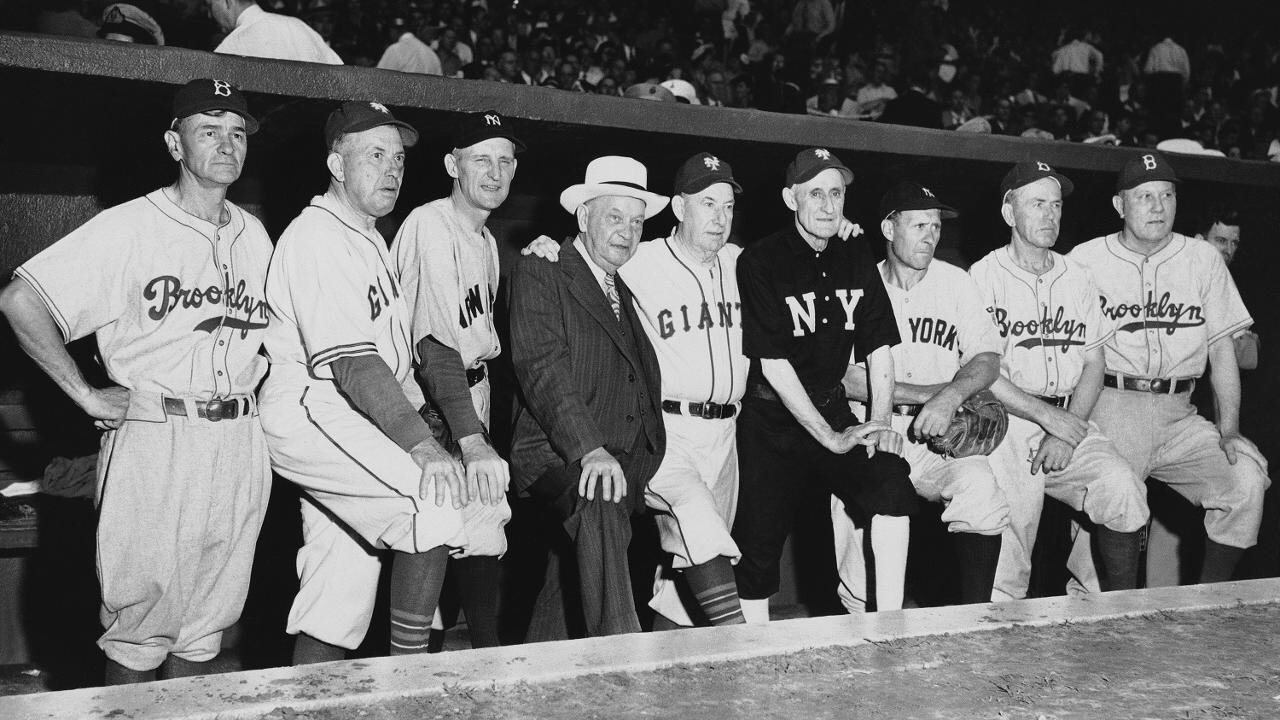
Dickey, Pennock, Schang

The crowd of 50,000 contributes $5.5 million to attend, while the Bond Clothing Co. pays $1 million in bonds for an autographed program. The overwhelming majority of the money comes from the city of New York, with Mayor Fiorello La Guardia purchasing $50 million worth of bonds. 

Hitting,  Running , Throwing

The three-cornered baseball game started with Hitting, running, and throwing contests. In between contests, Al Schacht, the Clown Prince of Baseball, entertained the crowd of 50,000, and admission to the game was by purchase of series E, F, and G war bonds. The 40,000 general admission unreserved seats cost one $25 war bond; the 5,809 reserved seats in the lower stands went for a $100 bond; the box seats both upper and lower cost the fan a $1,000 war bond. Bleacher seats were free to servicemen. 
Dickey, Pennock, Schang

Dickey, Pennock, Schang

 Between the Contests and the game took center stage at second base where radio and movie comedian Milton Berle “boisterously ushered in” a series of musical numbers. Then former Mayor James J. Walker took charge as master of ceremonies to introduce some New York baseball oldtimers: Zack Wheat, Nap Rucker and Otto Miller of the Dodgers; the Giants’ Roger Bresnahan, George (Hooks) Wiltse, and Moose McCormick; the Yankees’ Wally Schang, Herb Pennock, and U.S. Navy Lieutenant Commander Bill Dickey.

Giants vs Dodgers vs Yankees

Giants vs Dodgers vs Yankees – The setup for a three-way nine inning game was simple: The Dodgers and Yankees played the first inning while the Giants sat out; the Dodgers and Giants played the second inning while the Yankees sat out; the Yankees and Giants played the third inning while the Dodgers sat out. The same order continued to the game’s end.

Scoreboard
Scoreboard

Baseball Jerseys

In 1944, during the World War II era, baseball jerseys mirrored the broader societal focus on simplicity and functionality. Made primarily from wool, these jerseys were heavier and less breathable than modern materials. The designs were generally plain, featuring block colors with the team’s name or city embroidered across the chest, often in felt lettering. Numbers on the back of the jerseys were becoming standard, but they were usually simple in design without any shadowing or embellishing effects. Due to wartime rationing, the jerseys lacked the ornate logos and embellishments seen in earlier and later years. Despite these constraints, the classic style of 1944 baseball jerseys is remembered for its straightforward, unadorned aesthetic that reflected the resilience and spirit of the era. A style still appreciated today by collectors and fans interested in classic team apparel such as Chicago Cubs Jerseys.

Fifth War Bond

Fifth War Bond
Fifth War Bond

This is a 1944 Dodgers Yankees Giants Tri-Cornered Baseball Game Polo Grounds Fifth War Loan Program. The glossy 16 page, black & white program was issued by the War Bond Sports committee. Listed in the program’s centerfold rosters are the following Hall of Fame members: Dodgers Paul Waner and Leo Durocher, Giants Joe Medwick, Mel Ott and Ernie Lombardi, Yankees Joe McCarthy and Umpire Jocko Conlan. Many other stars of the time are also listed: Dixie Walker, Ed Stanky, Ralph Branca, Howie Schultz, Whit Wyatt, Augie Galan, Billy Jurges, Gus Mancuso, Buddy Kerr, Johnny Allen, George Stirnweiss, Hank Borowy, Joe Page.

Partial Source: http://keymancollectibles.com/publications/threewaygame.htm

Posted on Leave a comment

Basketball – March Madness

March Madness 2014

Basketball – NCAA History

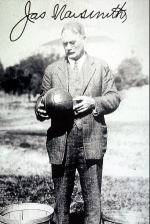
Dr. James Naismith

There are three special names for NCAA College Championship rounds (March Madness).

The tournament starts with sixty-four teams. After the 1st round  thirty-two teams remain.

The names begin on the 2nd round:

  • Sweet Sixteen (round 2)
  • Elite Eight (round 3)
  • Final Four (round 4)

At this stage the final two teams play for the NCAA Championship. It’s March Madness!

Basketball History

James Naismith
James Naismith

Dr. James Naismith is known world-wide as the inventor of basketball. He was born in 1861 in Ramsay township, near Almonte, Ontario, Canada. The concept of basketball was born from Naismith’s school days in the area where he played a simple child’s game known as duck-on-a-rock outside his one-room schoolhouse. The game involved attempting to knock a “duck” off the top of a large rock by tossing another rock at it. Naismith went on to attend McGill University in Montreal, Quebec, Canada.

Duck on the Rock

After serving as McGill’s Athletic Director, James Naismith moved on to the YMCA Training School in Springfield, Massachusetts, USA in 1891, where the sport of basketball was born. In Springfield, Naismith was faced with the problem of finding a sport that was suitable for play inside during the Massachusetts winter for the students at the School for Christian Workers.

December 21, 1891 First Game of Basketball Played in Springfield

Naismith wanted to create a game of skill for the students instead of one that relied solely on strength. He needed a game that could be played indoors in a relatively small space. The first game was played with a soccer ball and two peach baskets used as goals. Naismith joined the University of Kansas faculty in 1898, teaching physical education and being a chaplain.

The original 1891 Basket Ball court in Springfield College

Continue reading Basketball – March Madness

Posted on Leave a comment

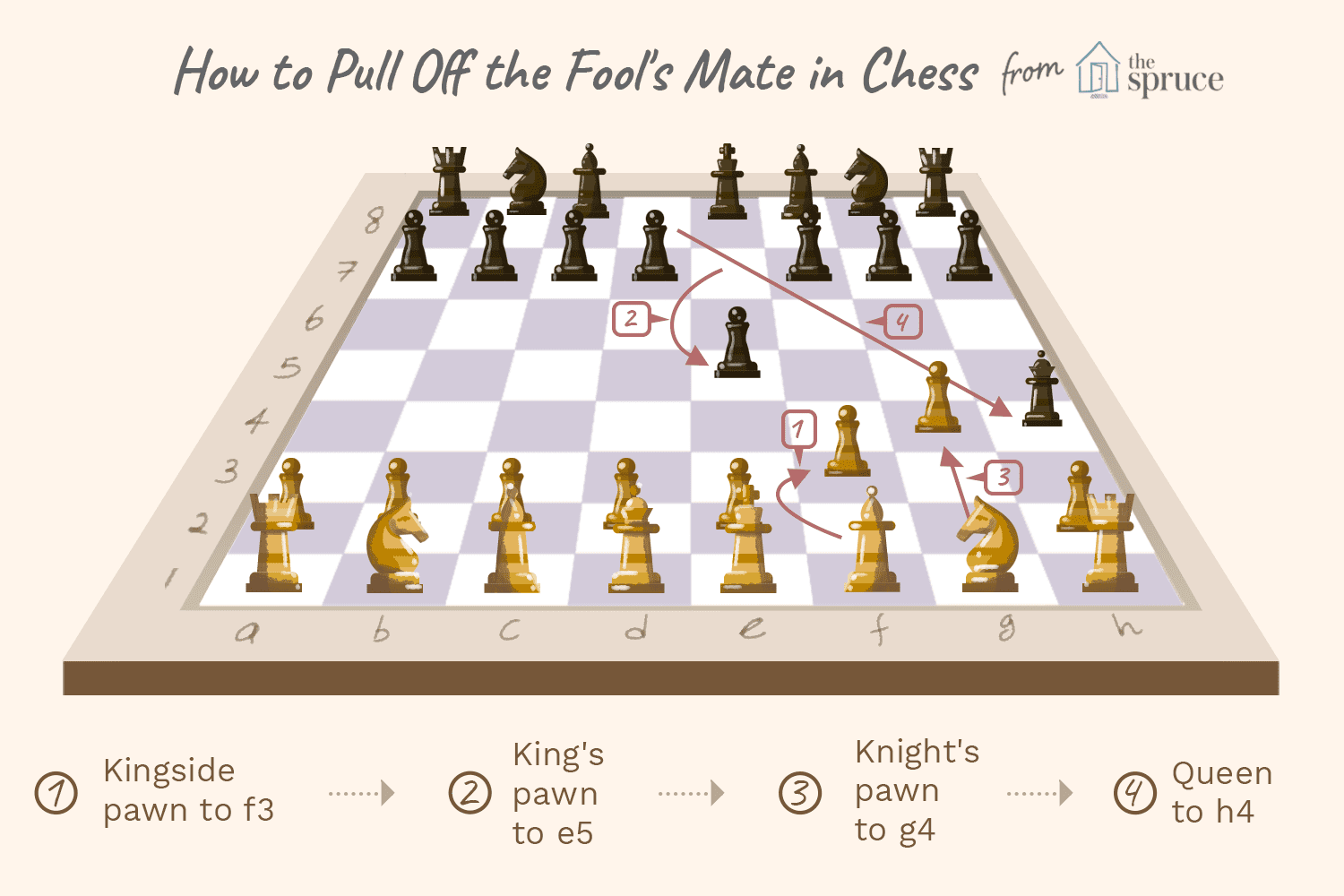
How to Achieve Checkmate in 3 Moves-Chess

fools-mate the fastest checkmate
checkmate 3 moves
checkmate 3 moves

There is the 2-move checkmate, or Fool’s Mate, and the 4-move checkmate, or Scholar’s Mate, but do you know the 3-move checkmate? Grab a friend, play white, and your next game of chess will take longer to set up than to play. You can achieve checkmate in three moves with capturing, or without capturing. For either of these methods to work requires some pretty bad play from your opponent, but maybe you can catch her cold at the start.

One way to do this:

1. Move your King Pawn forward to e4. In both of these methods the key piece for you is your Queen. The Queen is the piece that you are going to use to achieve the checkmate, so your first move should be to open up space for the Queen to move diagonally. Moving the King Pawn forward two spaces to square e4 achieves this (e4).

2. Capture your opponent’s Pawn at f5. Now use your Pawn to capture your opponent’s advanced Pawn by attacking on the diagonal. Notated, that’s e4xf5. Here you are trying to encourage your opponent to move their Knight Pawn forward two spaces to g5, so it is alongside your Pawn.

3. Move your White Queen to h5 (Qh5). Checkmate! Now you can move your Queen on the diagonal to h5 and you have your opponents King pinned. That’s game over! You’ll notice that if your opponent hadn’t moved their Pawn forward two in their last turn they could have blocked off your Queen by putting a pawn in her way by g6.

Call out checkmate! Now you can take the King with your Queen on the diagonal and celebrate a very swift victory. If your opponent has fallen into the trap they will likely be a bit annoyed, so don’t gloat too much!

See the video for a good explanation:

How to Achieve Checkmate in 3 Moves-Chess

Source: Youtube and https://www.wikihow.com/Checkmate-in-3-Moves-in-Chess