Posted on Leave a comment

Fat and Oil

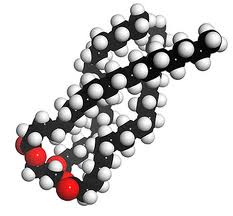
triacylglycerolFat and oil are both triacylglycerols (a triacylglycerol is an ester formed from glycerol and three fatty acids). Fat is solid at room temperature and oil is liquid at room temperature.

To name an ester,
1. Identify the alcohol and carboxylic acid from which the ester is formed.

2. Name the alkyl group corresponding to the alcohol and add the name of the carboxylic acid with the -oic acid changed to -ate (e.g., propanol + ethanoic acid  propyl ethanoate).

© 1996-2007 Eric W. Weisstein

triacylglycerol – tri·ac·yl·glyc·er·ol (tr-sl-gls-rôl, -rl) n. A naturally occurring ester of three fatty acids and glycerol that is the chief constituent of fats and oils. Also called triglyceride.

The American Heritage® Medical Dictionary Copyright © 2007, 2004 by Houghton Mifflin Company. Published by Houghton Mifflin Company. All rights reserved.

Posted on Leave a comment

THE FORCES OF NATURE

Nick HerbertText: Nick Herbert ///// Metalwork: August O’ConnorAugust O'Connor

“The forces of nature are phase forces.”– C. N. Yang

“The notion of local gauge invariance provides a framework of almost comical simplicity 
for the precise laws of physical interaction.”– Bruce Schumm

Physicists can describe the immense variety of the natural world by invoking only four fundamental forces. Until recently these four forces seemed to be arbitrary facts of nature but the discovery (outlined in UCSC physicist Bruce Schumm’s accessible book “Deep Down Things”) that the behavior of three of these forces can be derived from the operations of certain “symmetry groups” is one of the most exciting accomplishments in physics. Instead of accepting these forces as arbitrary facts of nature, physicists can now derive in precise detail three fundamental forces–electromagnetism, the weak and the strong nuclear forces (but not gravity)–from the transformation properties of three particular symmetry groups. Everything about the force follows from the theory (the number of “force particles”, for instance and whether these force particles self-interact or not) What needs to be supplied by experiment is one number for each force–the measured overall strength (or “charge”) of the interaction. Except for this one number every other feature of these forces is determined by the mathematical structure of its associated symmetry group–an extraordinary explanatory economy (in Schumm’s words) of “almost comical simplicity”.

Continue reading THE FORCES OF NATURE

Posted on Leave a comment

Johannes Stark

Johannes Stark
Johannes Stark
We have learnt through experience that when an electrical ray strikes the surface of an atom, an electron, and in some circumstances a second and even a third electron, can be detached.