Posted on Leave a comment

Human Memory

memory There are generally three types of memory: 

  1. sensory memory
  2. short-term memory
  3. long-term memory.

Sensory memory

The sensory memories act as buffers for stimuli received through the senses. A sensory memory exists for each sensory channel: iconic memory for visual stimuli, echoic memory for aural stimuli and haptic memory for touch. Information is passed from sensory memory into short-term memory by attention, thereby filtering the stimuli to only those which are of interest at a given time.

Short-term memory

Short-term memory acts as a scratch-pad for temporary recall of the information under process. For instance, in order to understand this sentence you need to hold in your mind the beginning of the sentence you read the rest.

Short term memory decays rapidly (200 ms.) and also has a limited capacity. Chunking of information can lead to an increase in the short term memory capacity. This is the reason why a hyphenated phone number is easier to rememeber than a single long number. The successful formation of a chunk is known as closure. Interference often causes disturbance in short-term memory retention. This accounts for the desire to complete the tasks held in short term memory as soon as possible.

Long-term memory

Long-term memory is intended for storage of information over a long time. Information from the working memory is transferred to it after a few seconds. Unlike in working memory, there is little decay.
 

Continue reading Human Memory

Posted on Leave a comment

Different types of north

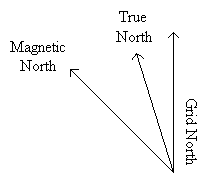
When working with a map and compass there are usually three different norths to be considered: True North, Grid North and Magnetic North. There is now a fourth: Google Maps North.  

True North

3 types of north

Each day the Earth rotates about its axis once. The ends of the axes are the True North and South poles. True North on a map is the direction of a line of longitude which converges on the North Pole.

Grid North

The grid lines on Ordnance Survey maps divide the UK into one kilometre squares, east of an imaginary zero point in the Atlantic Ocean, west of Cornwall. The grid lines point to a Grid North, varying slightly from True North. This variation is smallest along the central meridian (vertical line) of the map, and greatest at the map edges. The difference between grid north and true north is very small and for most navigation purposes can almost always be ignored.

Magnetic North

A compass needle points to the magnetic north pole. The magnetic north pole is currently located in the Baffin Island region of Canada, and from the UK, is west of true north. The horizontal angular difference between True North and Magnetic North is called MAGNETIC VARIATION or DECLINATION.

Continue reading Different types of north

Posted on 2 Comments

triune brain

triune brain
The neurologist Paul MacLean has proposed that our skull holds not one brain, but three, each representing a distinct evolutionary stratum that has formed upon the older layer before it, like an archaeological site. He calls it the “triune brain.”  MacLean, now the director of the Laboratory of Brain Evolution and Behaviour in Poolesville, Maryland, says that three brains operate like “three interconnected biological computers, [each] with its own special intelligence, its own subjectivity, its own sense of time and space and its own memory”.

Continue reading triune brain