Posted on Leave a comment

Thomas Fowler’s Ternary machine

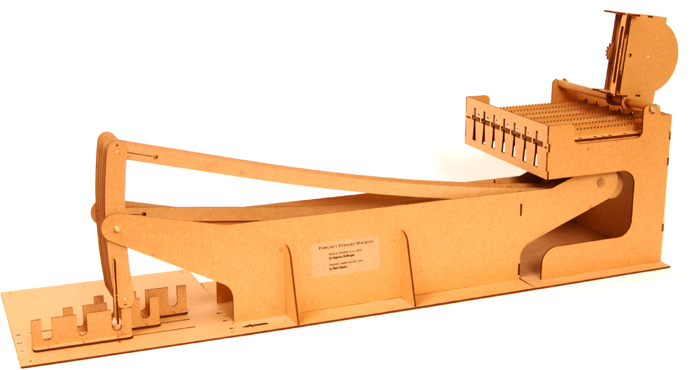
Thomas Fowler's ternary machine

A large, wooden calculating machine was built in 1840 by Thomas Fowler in his workshop in Great Torrington, Devon, England. In what may have been one of the first uses of lower bases for computing machinery, Fowler chose balanced ternary to represent the numbers in his machine. Very little evidence of this machine has survived.
Since 1997, two current Devon residents, Pamela Vass and David Hogan, have been researching Thomas Fowler and his inventions. They discovered a two-page description of Fowler’s calculating machine, written in 1840 by a prominent mathematician of the day, Augustus DeMorgan. Working together with Vass and Hogan, Mark Glusker designed and built the model shown above, based primarily on the information in DeMorgan’s description.

Read more about how Thomas Fowler made this machine and his ternary math at http://www.mortati.com/glusker/fowler/index.htm
Posted on Leave a comment

The neutrino matrix: why are there three of everything?

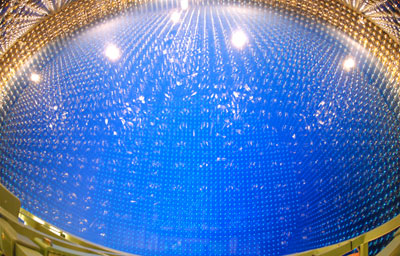
The SuperKamiokande detectorOctober 1, 2012 The Guardian UK

Last week’s results from the Daya Bay neutrino experiment were the first real measurement of the third neutrino mixing angle, θ13 (theta one-three). There have been previous experiments which set limits on the angle, but this is the first time it has been shown to be significantly different from zero.

Since θ13 is a fundamental parameter in the Standard Model of particle physics1, this would be an important measurement anyway. But there’s a bit more to it than that.

Neutrinos – whatever else they might be doing – mix up amongst themselves as they travel through space. This is a quantum mechanical effect, and comes from the fact that there are two ways of defining the three types of neutrino.


Continue reading The neutrino matrix: why are there three of everything?

Posted on Leave a comment

C, P & T Symmetries

The Standard model of particle physics has three related natural near-symmetries. These state that the actual universe about us is indistinguishable from one where:
  1. -Every particle is replaced with its antiparticle. This is C-symmetry (charge symmetry);
  2. -Everything appears as if reflected in a mirror. This is P-symmetry (parity symmetry);
  3. -The direction of time is reversed. This is T-symmetry (time symmetry).
These symmetries are near-symmetries because each is broken in the present-day universe. However, the Standard Model predicts that the combination of the three (that is, the simultaneous application of all three transformations) must be a symmetry, called CPT symmetry. CP violation, the violation of the combination of C- and P-symmetry, is necessary for the presence of significant amounts of baryonic matter in the universe. CP violation is a fruitful area of current research in particle physics.