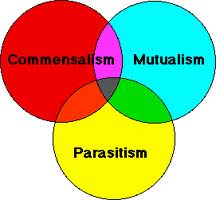
 The word symbiosis literally means “together life”. It refers to organisms that live in close approximation; often one cannot live without the other. In extreme cases, one organism actually lives inside the other organism.
There are 3 types of symbiosis:
1. Parasitism: parasite benefits, host is hurt.
Parasitism is a relationship in which one organism – the host – is the source of food and/or shelter for another organism, the parasite. In this relationship, all of the benefits go to the parasite; the host is harmed by the relationship. An example is a human and a tapeworm living in the intestines. The tapeworm derives food (and shelter) from the human host; the human is denied the nutrition that is consumed by the tapeworm.
2. Commensalism: one species benefits, the other is neither hurt nor helped.
In commensalism, one organism benefits from the relationship while the other is neither helped nor hurt. Example: a few orchids growing epiphytically on a tree. If there are a lot of commensals on a single “host” then it stands to reason that the host will be hurt and the relationship will slide towards the parasitic (Note: some ecologists define parasitism functionally, that is the parasite must be adapted to feed on the host; other ecologists define the terms logically, that is if the host is hurt and the parasite benefits then the relationship is parasitic, even if feeding does not take place. This latter definition makes many commensal relationships appear parasitic. )
3. Mutualism: both species benefit
Finally we come to mutualistic relationships where both parties benefit. In fact, many people use the term symbiosis a bit too casually, using the term symbiosis to refer to mutualistic relationships (they should really call a relationship where both species benefit mutualistic instead of symbiotic, as the latter term leaves open the possibility that the relationship could be mutualistic, parasitic or commensal in nature). Example: corals and zooxanthellae (zooxanthellae are algae that take up residence in a coral animal. The photosynthetic zooxanthellae provide the coral with sugars in return for nitrogen and other nutrients from the coral).
Tightness and Looseness: All relationships between organisms range over a continuum from obligate (where one or both organisms would die without the other) to facultative (where the presence/absence of the other isn’t really necessary). Obligate relationships – such as a human tapeworm in our gut – are considered “tight“, while facultative ones – a squirrel living in a tree – are considered “loose“. Some ecologists place the 3 types of relationships first, that is there are parasitic, commensalistic, and mutualistic relationships, and only the obligate ones in any of these 3 categories are called symbioses.
Read more at http://www.marietta.edu/~biol/biomes/symbiosis.htm
Like this:
Like Loading...

 NASA probes spots temporary third Van Allen radiation belt


