Posted on Leave a comment

Venn diagram

Venn diagrams are today’s mostly used method for solving syllogisms. With some practice they can be drawn fairly quickly making them a valuable tool in solving syllogisms in timed aptitude tests. Venn diagrams show all possible and hypothetically logical relations between a collection of finite and infinite statements. By means of an overlap between some certain assumptions conclusions can be made using the (in)finite statements. Two examples of the use of Venn diagrams will follow to clarify the above.

Example 1:

  1. All Canadians are right handed
  2. All right handed are opticians
  3. Conclusion: Some opticians are Canadian

To check the validity of this statement first the different terms are appointed.

Subject:        Canadian
Predicate:      Optician
Middle term:    Right handed

We will start with the first out of the two given statements from above. The first thing to do is draw two circles and write the terms Canadian and Right handed in them. The circle with the word Canadian without the overlap represents only Canadian people, while the part within the overlap with the right handed circle represents all Right handed Canadian people. Everything outside these two circles represents everything not connected to these two terms. With this one can think of plants, animals, cars but even you and me.

statement-a-1

Continue reading Venn diagram

Posted on 1 Comment

Triple point

Triple point

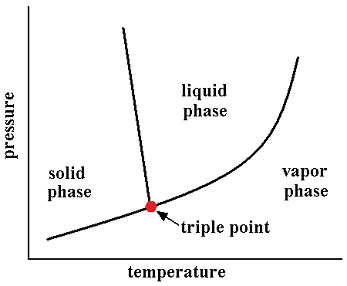
In thermodynamics, the triple point of a substance is the temperature and pressure at which three phases (for example, gas, liquid, and solid) of that substance coexist in thermodynamic equilibrium. For example, the triple point of mercury occurs at a temperature of -38.8344 °C and a pressure of 0.2 mPa.

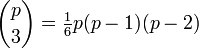
In addition to the triple point between solid, liquid, and gas, there can be triple points involving more than one solid phase, for substances with multiple polymorphs. Helium-4 is a special case that presents a triple point involving two different fluid phases (see lambda point). In general, for a system with p possible phases, there are

Triple Point formula


triple points.

The triple point of water is used to define the kelvin, the SI base unit of thermodynamic temperature.[2] The number given for the temperature of the triple point of water is an exact definition rather than a measured quantity. The triple points of several substances are used to define points in the ITS-90 international temperature scale, ranging from the triple point of hydrogen (13.8033 K) to the triple point of water (273.16 K).

Triple point cells

Triple point cells are used in the calibration of thermometers. For exacting work, triple point cells are typically filled with a highly pure chemical substance such as hydrogen, argon, mercury, or water (depending on the desired temperature). The purity of these substances can be such that only one part in a million is a contaminant, called “six nines” because it is 99.9999% pure. When it is a water-based cell, a special isotopic composition called VSMOW is used because it is very pure and produces temperatures that are more comparable from lab to lab. Triple point cells are so effective at achieving highly precise, reproducible temperatures, an international calibration standard for thermometers called ITS–90 relies upon triple point cells of hydrogen, neon, oxygen, argon, mercury, and water for delineating six of its defined temperature points.

Read Full Article 

The article content of this page came from Wikipedia and is governed by CC-BY-SA.
Posted on Leave a comment

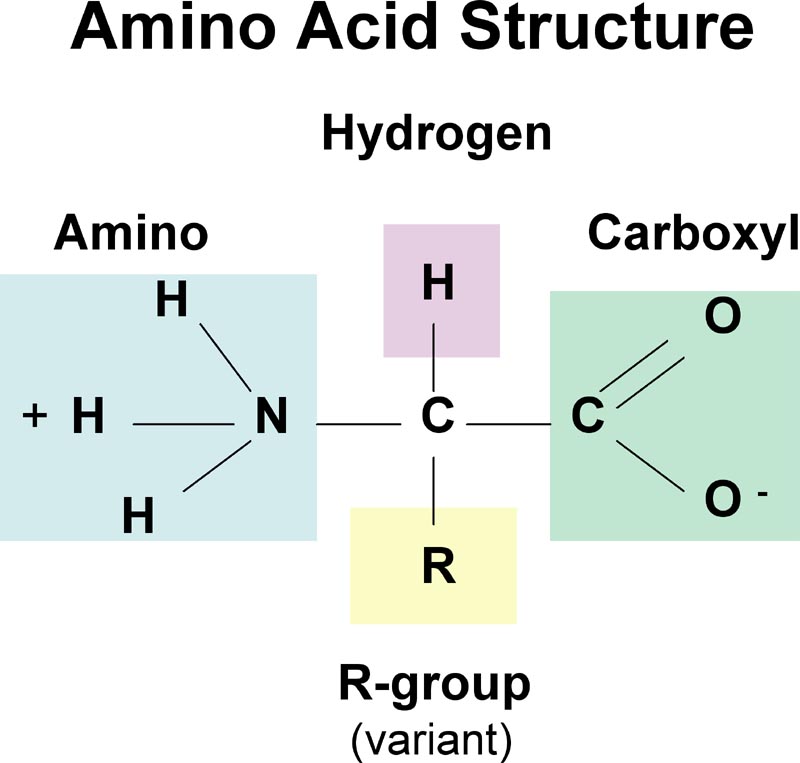
The Twenty Amino Acids

Amino Acids

Amino acids are organic compounds that combine to form proteins. Amino acids and proteins are the building blocks of life.

When proteins are digested or broken down, amino acids are left. The human body needs a number of amino acids to:
 
Break down food
Grow
Repair body tissue
Perform many other body functions
 
Amino acids are classified into three groups:
  1. Essential amino acids
  2. Nonessential amino acids
  3. Conditional amino acids