
“The Little Mermaid” (Danish: Den lille havfrue) is a fairy tale by the Danish poet and author Hans Christian Andersen about a young mermaid willing to give up her life in the sea and her identity as a mermaid to gain a human soul and the love of a human prince.
Written originally as a ballet, the tale was first published in 1837 and has been adapted to various media including musical theatre and animated film.
retold by Robert Hoffman
Big out in the ocean, where the water is as blue as the prettiest cornflower, and as clear as crystal, it is very, very deep; so deep, indeed, that no cable could fathom it: many church steeples, piled one upon another, would not reach from the ground beneath to the surface of the water above. There dwell the Sea King and his subjects. We must not imagine that there is nothing at the bottom of the sea but bare yellow sand. No, indeed; the most singular flowers and plants grow there; the leaves and stems of which are so pliant, that the slightest agitation of the water causes them to stir as if they had life.
Fishes, both large and small, glide between the branches, as birds fly among the trees here upon land. In the deepest spot of all, stands the castle of the Sea King. Its walls are built of coral, and the long, gothic windows are of the clearest amber. The roof is formed of shells, that open and close as the water flows over them. Their appearance is very beautiful, for in each lies a glittering pearl, which would be fit for the diadem of a queen.
 A mountain range in Western China, believed to be a Taoist paradise. It is one of the ten continents and three islands in Taoist cosmology, and is said to be three (or nine) stories high. Whoever manages to climb to the top gains access to the heavens. It also extends three (or nine) stories below the Earth, thereby connecting the subterranean watery realm of the dead with the realm of the gods.
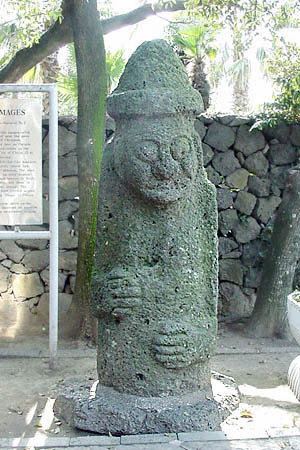 This myth tells of the first settlement on Cheju Island, located off the southern coast of the Korean Peninsula. In the beginning, before any people roamed the land, three demi-gods (Yangeulla, Koeulla, Pueulla) emerged from the ground. They wandered through the land and hunted, making clothes from the skins and subsisting on the meat.


