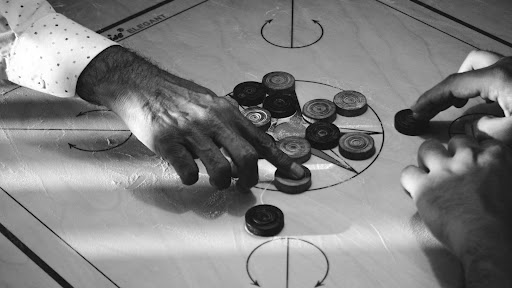
The card is still face down. Someone reaches for it, then stops to look around the table. Has the next player worked out what is coming? That little pause is often the best part of a game. Nothing has happened yet, but everyone is waiting for something to happen. Three things can make such a moment work: what players do not know, what they cannot control, and what they decide to do anyway.
Something Is Still Hidden
Think about a game of cards. You can study your own hand, remember what has already been played, and watch the other players. You still cannot see their cards. A strong move might be obvious if you had all the facts; without them, you have to make a judgment.
Mystery games use the same gap. One clue points toward a suspect, but another makes the explanation less certain. The fun comes from testing a theory as each new piece of information appears. A reveal is satisfying when you can look back and spot the clues you missed. If the answer could have been anything, there was little reason to pay attention in the first place.
Even a simple guessing game can create that feeling. The person giving clues knows the answer. Everyone else listens for a useful detail, revises a guess, and hopes to get there before the next player. One vague hint can prompt a dozen interpretations; one precise hint can settle the whole table. The secret gives each turn a purpose.
The Next Turn Might Surprise You
Now picture a board game in which you need one particular number on the dice. You can plan for a good roll, but you cannot order one. The dice may open a route you had not considered or leave you to deal with an awkward position.
Chance is most interesting when there is still something to do afterward. Drawing a poor card may force you to change tactics. Drawing the perfect one may tempt you to use it immediately, though saving it could pay off later. The random event starts the problem; the player has to respond.
Uncertain outcomes also feature in casino games, where the rules and odds depend on the game. Adults who choose to play online casino games should check the rules and set a spending limit beforehand. A lucky result is possible, but it is no basis for expecting an income. Players must meet the legal age requirement where they live.
A Decision Has Consequences
Suppose you have a card that can stop another player. Use it now, or keep it for a more dangerous turn? Neither choice is guaranteed to be right. That is why the decision sticks in your mind after the round ends.
Choices need not be elaborate. In tic-tac-toe, one square can set up your win or block your opponent’s. In a team game, helping one teammate may leave another without what they need.
This is also why people tell stories about games afterward. They remember the clue they ignored, the improbable draw, or the move they wish they could take back. A score records who won; a decision explains how the game felt.
Conclusion
Hidden information gives players a question. Chance interrupts their plans. Choice makes the outcome feel personal. A game does not need all three in equal measure, but when they meet at the right moment, even one turn can be worth talking about afterward.
Three is one of the most useful numbers in game design. Two choices can feel predictable, while four or five may require too much explanation. Three creates enough variety to support tactics without making a game difficult to understand.
This pattern appears in simple playground contests, tabletop games and competitive matches. A player may choose between attacking, defending and waiting, or between speed, strength and flexibility. Each option has value, but none is powerful in every situation.
Rock, Paper, Scissors Creates a Perfect Loop
Rock, paper, scissors is the clearest example of a three-part system. Rock defeats scissors, scissors defeat paper and paper defeats rock. Every choice is strong against one option and vulnerable to another.
The rules can be learned in less than a minute, yet players still look for patterns in an opponent’s behaviour. They may consider the previous round, anticipate a repeated move or deliberately make a choice that appears unlikely. The physical actions are simple, but the decision behind each one can be surprisingly complex.
This circular relationship prevents any single move from becoming permanently dominant. The game remains balanced because advantage keeps moving around the triangle.
Clear Rules Make Strategy Visible
A game becomes more enjoyable when players understand what their choices mean. Confusing instructions can hide an elegant system beneath questions about legal moves, turn order and scoring.
Resources such as Playiro bring together guides for card, board and party games, helping players review the rules before beginning. This can be especially useful when a familiar game has regional variations or when nobody in the group has played it recently.
Once the practical details are settled, attention can move from interpreting the instructions to making decisions. Players begin to notice which options create opportunities, which carry risks and how one move may affect the next.
Three Creates Meaningful Tension
A good choice needs more than one obvious answer. When three options interact, the player must often balance competing priorities.
One approach may offer an immediate advantage, another may provide protection, and a third may create a better position for a later turn. The strongest choice therefore depends on timing and on what other players are expected to do.
Three-part systems can also prevent a match from becoming a simple contest between opposites. A third possibility disrupts the balance, forcing players to reconsider assumptions and prepare for more than one response.
Simple Games Can Reveal Complex Decisions
The apparent simplicity of rock, paper, scissors has attracted attention beyond casual play. Smithsonian Magazine has examined what the game can reveal about decision-making, including the patterns people follow rather than choosing entirely at random.
That observation helps explain why simple games can remain engaging. The rules may be fixed, but people bring habits, expectations and emotions into every round. A player who wins may repeat a move, while someone who loses may feel compelled to change direction. Strategy therefore emerges from the interaction between a balanced system and imperfect human behaviour.
The Pattern Extends Beyond Three Moves
Not every game presents three labelled options, yet many use a similar structure. A match may have an opening, a middle phase and an ending. A player may need to manage resources, position and timing. A team may divide responsibility between offence, defence and support.
Even a best-of-three format reflects the same appeal. One round can feel accidental, while a very long series may reduce urgency. Three rounds create room for an early mistake, a response and a decisive final result.
A Small Number With Lasting Appeal
The number three offers a productive balance between simplicity and variety. It is easy to remember, quick to explain and flexible enough to generate genuine uncertainty.
That is why three-part systems continue to appear across games of many kinds. They give players enough information to begin immediately, then reveal greater depth as people learn to read the choices in front of them.
People often assume that reading more means becoming more disciplined: choosing one book, finishing it, and only then allowing themselves to start another. That sounds sensible, but it can also make reading feel like homework.
A different approach is to keep three books going at once, each serving a different mood. One might be easy and entertaining, another more demanding, and a third something to dip into slowly. Instead of forcing the same book into every moment, you always have an option that suits the energy you actually have.
This makes reading easier to maintain because the habit stops depending on being in the perfect mood for one particular title. The goal is not racing through more books. It is making reading flexible enough that picking up a book becomes the natural choice more often.
Keep One Book for Quiet Evenings
The first book should be the one you naturally reach for when the day is winding down. It does not need to be intellectually demanding. In fact, this slot works best when the book feels easy to enter after work, dinner, or a long day.
Create a simple ritual around it. Make tea, put the phone away, sit somewhere comfortable, and give yourself twenty or thirty minutes without expecting to finish a chapter. Some adults also build relaxing products from places such as www.mrmoxeys.com into their evening routines, but the main idea is consistency: reading becomes easier when it is attached to a familiar period of downtime.
This evening book can be fiction, memoir, travel writing, or anything that feels enjoyable rather than productive. Its job is to make reading the obvious alternative to another hour of scrolling.
Choose a Second Book That Makes You Think
The second book can be more demanding. This might be history, science, business, philosophy, or a longer nonfiction title that requires more attention than the evening book.
Do not force yourself to read it when tired. Save it for mornings, weekends, lunch breaks, or any time concentration is stronger. Even ten focused pages can be more useful than thirty distracted ones.
Keeping this book separate from the relaxing one also removes the guilt that often comes with abandoning a challenging title halfway through the week. You are not abandoning it. You are simply reading it when your brain is actually available for it.
A bookmark, a few notes, or a short summary after each session can make it easier to return after several days without losing the thread.
Keep a Third Book Somewhere You Naturally Pause
The third book should work in fragments. Essays, short stories, poetry, photography books, interviews, or collections of brief chapters are ideal because they do not require forty uninterrupted minutes.
Place this book somewhere connected to natural pauses in the day. It could live beside a favorite chair, on a coffee table, or near a relaxation area at home. Someone who has built a wellness space around a home setup from https://premiumsaunas.com/ might keep a short-form book nearby for the quieter period before or after that routine.
The point is to make reading available without turning every session into a commitment. Five pages while waiting for something, ten minutes before leaving the house, or one essay on a Sunday afternoon all count.
Those small sessions accumulate faster than most people expect.
Photo by Nathan Aguirre on Unsplash
A common reason people stop reading is that they feel obligated to finish books they no longer enjoy.
There is no prize for forcing your way through something that has become a chore. Give a book enough time to establish itself, but if every reading session feels like resistance, put it aside.
Keeping three books going makes this decision easier because no single title carries the full weight of the habit. One can slow down while another becomes more interesting.
It also creates variety. A serious nonfiction book may feel perfect on Saturday morning and impossible on Tuesday night. A novel may do the opposite.
Reading more is often less about increasing willpower and more about reducing the number of moments when the available book feels wrong.
Match Books to Energy, Not to a Schedule
Rigid goals can help some readers, but they can also turn reading into another task to complete. Instead of insisting on thirty pages every day, think about what kind of reading fits the time and energy available.
Low-energy evening? Read the easiest book. Quiet morning with coffee? Pick up the demanding one. Ten free minutes before leaving? Read something short.
This flexibility makes the habit far more resilient. Missing one type of reading does not mean missing reading altogether.
It also helps prevent long gaps. If one book stalls because the topic becomes difficult or the plot slows down, the other two keep the routine moving.
The habit survives even when the individual book does not.
Make the Books Visible
Books that disappear onto crowded shelves are easy to forget. Keep the three active books somewhere visible and accessible.
One can stay by the bed, another near the desk, and the third in a bag or living room. That physical separation reinforces the idea that each book has its own role.
Avoid creating a huge “currently reading” pile. Three is enough to provide variety without creating confusion. Once one book is finished or dropped, replace it with another that serves the same purpose.
Digital readers can use the same system by creating a small collection of active titles rather than constantly browsing the entire library.
The easier it is to find the right book for the moment, the less likely the phone becomes the default.
Let the Habit Grow Naturally
Trying to read fifty books in a year can be motivating, but it can also push people toward speed rather than enjoyment. A three-book system works best when the focus stays on consistency.
Some weeks, all three books may move forward. Other weeks, one may barely be touched. That is fine.
The real benefit is that reading becomes available in several different forms. There is something for concentration, something for relaxation, and something for the in-between moments that normally disappear into a screen.
Over time, those small choices create more reading without requiring a dramatic lifestyle change.
You do not need more discipline to become someone who reads regularly. You may simply need more than one kind of book waiting for you.